
Wi-Fi CCTV Camera vs Wired CCTV Camera
Wi-Fi CCTV Camera
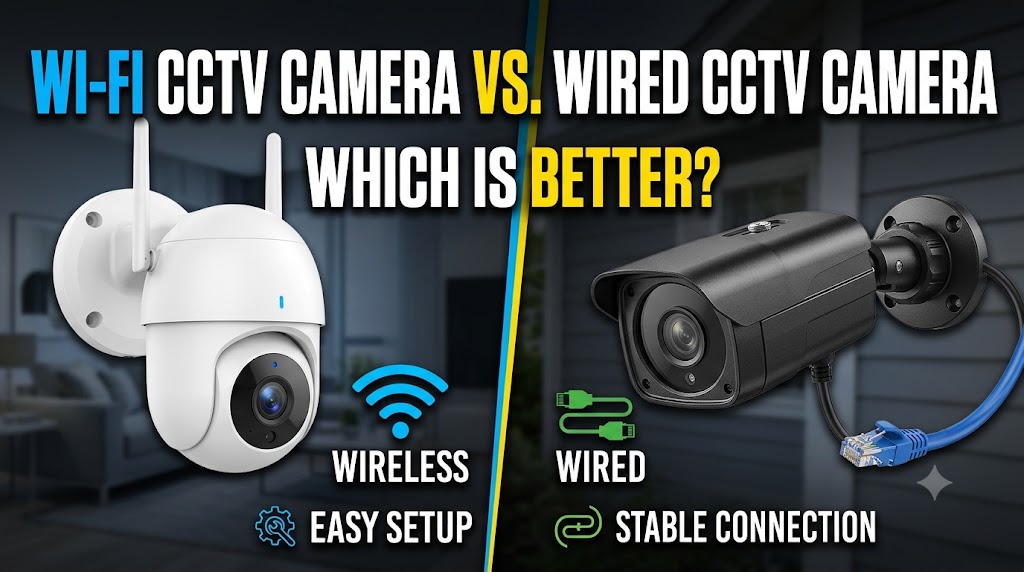
A Wi-Fi CCTV camera connects to the network wirelessly instead of using an Ethernet cable for its network connection. It can be particularly useful when running network cable to the camera location is difficult, such as in finished homes, rented properties or locations where drilling and cable routing are undesirable. Wi-Fi cameras still generally need a power source unless they are specifically designed for battery operation. Their practical performance depends on Wi-Fi signal strength, network congestion, distance from the router or access point and the camera’s supported wireless standard. (reolink.com)
Wired CCTV Camera
A wired CCTV camera uses a physical cable for its network or video connection. Modern IP cameras commonly use Ethernet, and PoE (Power over Ethernet) can carry both data and power through a single Ethernet cable. This makes wired installation particularly suitable for new construction, offices, shops and larger CCTV systems where reliable connectivity is important. Wired cameras also avoid depending on the camera’s Wi-Fi signal. Depending on the system, Ethernet cameras can connect to an NVR or PoE switch, while traditional analog cameras can use coaxial cabling. (tp-link.com)
Quick Comparison Table
| Feature | Wi-Fi CCTV Camera | Wired CCTV Camera |
|---|---|---|
| Network Connection | Wireless | Ethernet/coaxial cable |
| Power Requirement | Usually separate power | PoE can provide power + data through one cable |
| Installation | Easier where cabling is difficult | Requires cable routing |
| Wi-Fi Dependence | Yes | No for camera-to-network connection |
| Connection Stability | Depends on wireless signal and congestion | Generally more predictable |
| Bandwidth | Uses Wi-Fi network | Uses wired network |
| Interference | Can be affected by wireless conditions | Not affected by Wi-Fi interference |
| Long-Term Installation | Good when cabling is impractical | Excellent when cabling is possible |
| Expansion | Convenient in some locations | Requires additional cable/network capacity |
| Remote Viewing | Available with compatible network setup | Available with compatible network setup |
| Best For | Finished homes, difficult cable locations | Homes, shops, offices and larger systems |
| Overall Winner | Depends on Installation | Depends on Installation |
Important: “Wired” can mean different technologies. This article mainly refers to modern Ethernet/PoE IP cameras when discussing wired network CCTV. Traditional coaxial CCTV systems are another wired option.
1. Installation
| Wi-Fi CCTV Camera | Wired CCTV Camera |
|---|---|
| Does not require an Ethernet cable for network connectivity | Requires a physical network or video cable |
| Useful where cable routing is difficult | Requires cable planning and installation |
| Can reduce drilling and cable-routing work | Installation can require more physical work |
Wi-Fi’s biggest advantage is installation flexibility. If a camera location is far from the existing network infrastructure or the building is already finished, wireless connectivity can avoid running a new Ethernet cable.
However, the camera still needs power in most cases. A Wi-Fi camera therefore does not necessarily mean a completely cable-free installation.
Wired PoE cameras can use one Ethernet cable for both data and power, which simplifies the connection once the cable has been installed. (tp-link.com)
What this means for you: If you cannot easily run cable, Wi-Fi is convenient. If you are building or renovating and can run Ethernet cable, wired CCTV is usually easier to plan for a permanent installation.
🏆 Winner: Wi-Fi for Easy Installation
2. Connection Stability
| Wi-Fi CCTV Camera | Wired CCTV Camera |
|---|---|
| Depends on Wi-Fi signal strength and network conditions | Uses a physical connection |
| Can be affected by distance, obstacles and congestion | Generally provides a more predictable connection |
| Good performance requires reliable wireless coverage | Does not depend on camera Wi-Fi coverage |
Wi-Fi cameras depend on the wireless connection between the camera and the access point/router. Wireless conditions can vary according to distance, walls and network congestion.
Reolink notes that Wi-Fi 6 cameras can provide improved resistance to interference and recommends a range extender or mesh system when the camera is installed where wireless coverage is poor. (reolink.com)
A wired Ethernet connection does not have this particular wireless-signal dependency.
What this means for you: If the camera is far from the router or behind several walls, wired connectivity is generally the safer choice.
🏆 Winner: Wired CCTV Camera
3. Video Quality
| Wi-Fi CCTV Camera | Wired CCTV Camera |
|---|---|
| Can support high-resolution video | Can support high-resolution video |
| Image quality depends on the camera’s sensor and lens | Image quality depends on the camera’s sensor and lens |
| Wireless connection quality can affect transmission | Wired network generally provides a predictable connection |
The connection type itself does not automatically determine image quality.
A good Wi-Fi camera can produce better images than a poor wired camera. Resolution, sensor, lens, WDR, low-light performance and image processing remain important.
Modern wired IP cameras can also support high resolutions and advanced functions. For example, current PoE cameras include 4MP models with AI classification, night vision and H.265+ compression. (tp-link.com)
What this means for you: Compare the actual camera specifications rather than assuming that wired automatically means better picture quality.
🏆 Winner: Tie
4. Reliability for 24/7 Surveillance
| Wi-Fi CCTV Camera | Wired CCTV Camera |
|---|---|
| Requires a stable wireless connection | Physical network connection |
| Wireless conditions can change | Connection is generally more predictable |
| Suitable for many home installations | Particularly suitable for continuous surveillance systems |
For security cameras that are expected to operate continuously, connection reliability is important.
Wi-Fi can work very well when the access point is properly positioned and the wireless signal remains strong. But the camera remains dependent on the wireless network.
A wired connection removes that particular dependency and is therefore generally preferred for permanent surveillance installations where running cable is practical.
TP-Link’s current guidance similarly recommends PoE where cable can be run and Wi-Fi where cabling is impractical. (tp-link.com)
What this means for you: For a shop, office, warehouse or other location where CCTV is critical, wired is generally the more predictable option.
🏆 Winner: Wired CCTV Camera
5. Power Supply
| Wi-Fi CCTV Camera | Wired CCTV Camera |
|---|---|
| Usually requires a separate power connection | PoE can provide both power and data through one Ethernet cable |
| Some battery-powered models exist | PoE simplifies power delivery |
| Power location must be considered during installation | One cable can handle both functions on compatible systems |
A common misconception is that Wi-Fi cameras do not need cables. In reality, many Wi-Fi CCTV cameras still require a power adapter.
PoE cameras provide an important alternative: one Ethernet cable can carry both power and data. TP-Link’s VIGI cameras, for example, support PoE so that power and data can be handled through a single RJ45 cable. (tp-link.com)
What this means for you: If you want the cleanest permanent installation, PoE can be a major advantage because one cable can handle both power and network connectivity.
🏆 Winner: Wired CCTV Camera
6. Wi-Fi Interference and Network Congestion
| Wi-Fi CCTV Camera | Wired CCTV Camera |
|---|---|
| Shares wireless spectrum/network capacity with other devices | Uses physical Ethernet connectivity |
| Performance can depend on wireless congestion | Less affected by Wi-Fi congestion |
| Modern Wi-Fi standards can improve performance | Does not rely on Wi-Fi signal |
A Wi-Fi CCTV camera shares the wireless environment with phones, laptops, smart TVs, access points and other wireless devices.
Modern Wi-Fi standards can improve efficiency. Wi-Fi 6, for example, incorporates technologies designed to improve performance in congested wireless environments. (reolink.com)
Nevertheless, wired Ethernet avoids the camera-to-network wireless link altogether.
What this means for you: If your property already has many Wi-Fi devices or several Wi-Fi cameras, wired CCTV can reduce dependence on wireless capacity.
🏆 Winner: Wired CCTV Camera
7. Distance and Coverage
| Wi-Fi CCTV Camera | Wired CCTV Camera |
|---|---|
| Coverage depends on router/access-point placement and obstacles | Can use Ethernet cabling to reach camera locations |
| Mesh systems/extenders can help in difficult areas | Cable routing determines installation distance |
| Very useful where cable routing is difficult | Very useful where structured cabling is available |
Wi-Fi can be particularly useful for locations such as detached areas, finished buildings or places where installing cable would be expensive or disruptive.
Wired systems can also cover substantial distances, but the installer must plan cable routes and network infrastructure appropriately.
Some PoE networking equipment supports extended transmission distances for IP-camera deployments, depending on the equipment and configuration. (tp-link.com)
What this means for you: If cable routing is the main problem, Wi-Fi may be the more practical solution. If cabling is available, wired remains highly predictable.
🏆 Winner: Depends on Installation
8. Security
| Wi-Fi CCTV Camera | Wired CCTV Camera |
|---|---|
| Wireless connection must be properly secured | Physical network connection reduces dependence on wireless security |
| Strong Wi-Fi encryption and secure passwords are important | Network security and device credentials remain important |
| Modern Wi-Fi technologies can provide strong encryption | Wired does not mean automatically secure |
Neither connection type should be considered automatically secure.
A Wi-Fi camera should use strong authentication, current firmware and appropriate wireless security. Reolink’s Wi-Fi 6 security-camera information, for example, highlights WPA3 support on compatible products. (reolink.com)
Wired systems also need secure passwords, updated firmware, protected network equipment and appropriate remote-access settings.
What this means for you: Do not choose Wi-Fi or wired solely on the assumption that one is automatically secure. Proper network configuration matters.
🏆 Winner: Tie
9. Storage and Recording
| Wi-Fi CCTV Camera | Wired CCTV Camera |
|---|---|
| Can record to microSD, cloud or NVR depending on model | Can record to NVR, DVR or local storage depending on system |
| Wireless connection carries video to the recording destination | Wired connection carries video to the recorder |
| Storage capacity depends on the recording system | Storage capacity depends on the recording system |
Both types can support different recording methods.
A Wi-Fi camera may use local microSD storage or a cloud service, while many wired IP-camera systems use an NVR. Some Wi-Fi cameras can also integrate with compatible recorders.
Modern IP cameras can use video compression such as H.265+ to reduce storage and network requirements. TP-Link’s current VIGI cameras provide examples of this approach. (tp-link.com)
What this means for you: Choose the recording method first. If you want a centralized multi-camera NVR system, wired PoE is often the cleaner approach.
🏆 Winner: Wired CCTV Camera for Centralized Systems
10. Number of Cameras
| Wi-Fi CCTV Camera | Wired CCTV Camera |
|---|---|
| Multiple cameras can share the wireless network | Multiple cameras can connect through PoE switches/NVRs |
| Wireless capacity becomes increasingly important as cameras are added | Network infrastructure can be planned for the required camera count |
| Suitable for smaller or selectively placed cameras | Particularly suitable for larger installations |
One or two Wi-Fi cameras can be easy to deploy, but adding many high-resolution wireless cameras increases the demand on the wireless network.
Wired systems can use PoE switches and NVRs designed for multiple cameras. TP-Link’s PoE systems, for example, are specifically designed to simplify IP-camera deployment. (tp-link.com)
What this means for you: For a larger CCTV installation, plan the network rather than simply adding cameras one by one.
🏆 Winner: Wired CCTV Camera
11. Best Choice for Home
| Wi-Fi CCTV Camera | Wired CCTV Camera |
|---|---|
| Excellent for apartments and finished homes | Excellent for new homes and permanent installations |
| Easier where cable installation is difficult | Better when Ethernet cabling can be installed |
| Useful for one or a few strategically placed cameras | Better for centralized multi-camera systems |
For a small home installation, Wi-Fi can be very convenient.
For example, if you want one camera monitoring a front door and there is no easy way to run Ethernet cable, a reliable Wi-Fi camera may be the simplest solution.
If you are installing cameras throughout a newly constructed house, wired PoE can provide a more structured and predictable system.
What this means for you: For homes, the best choice depends heavily on whether you can conveniently install Ethernet cabling.
🏆 Winner: Depends on the Home
12. Best Choice for Shops and Businesses
| Wi-Fi CCTV Camera | Wired CCTV Camera |
|---|---|
| Useful for temporary or difficult-to-wire locations | Strong choice for permanent business surveillance |
| Suitable for selected cameras | Suitable for multiple-camera systems |
| Network dependency should be carefully considered | Predictable physical connectivity |
Businesses often need continuous surveillance, multiple cameras and centralized recording.
That makes wired PoE particularly attractive when cable installation is possible.
Wi-Fi can still be useful for a specific location where running cable is impractical.
What this means for you: For a permanent shop or office CCTV system, wired is generally the safer default.
🏆 Winner: Wired CCTV Camera
13. Installation Cost
| Wi-Fi CCTV Camera | Wired CCTV Camera |
|---|---|
| Can reduce cable-installation work | Requires Ethernet/coaxial cable infrastructure |
| Potentially cheaper to install where cable routing is difficult | Initial installation can cost more because of cabling |
| Power still needs to be considered | PoE can combine power and data in one cable |
Wi-Fi can reduce installation work when cable routes are difficult.
However, it would be incorrect to say that Wi-Fi CCTV is always cheaper. The system may require power adapters, stronger Wi-Fi equipment, mesh nodes or additional networking infrastructure.
Similarly, wired CCTV can become cost-effective when several cameras are installed together because structured cabling and PoE can simplify the system.
What this means for you: Compare the complete installation cost, not just the camera price.
🏆 Winner: Depends on Installation
14. Internet Requirement
| Wi-Fi CCTV Camera | Wired CCTV Camera |
|---|---|
| Wi-Fi connection can be used for network communication | Wired IP cameras can work on a local Ethernet network |
| Internet may be required for certain cloud/remote features | Internet may be required for certain cloud/remote features |
| Local recording can still be possible on supported models | Local NVR recording can work without continuous internet access |
A major misconception is that a wired CCTV camera automatically requires the internet.
A local IP-camera system can communicate with an NVR over the local network without requiring the internet for basic local recording. Internet access is generally relevant when you want remote viewing, cloud services or other online functions.
Wi-Fi also does not automatically mean internet. A Wi-Fi camera can communicate over a local wireless network, depending on its design and recording system.
What this means for you: Distinguish between Wi-Fi connectivity, local networking and internet access when choosing a CCTV system.
🏆 Winner: Tie
15. Which One Should You Choose?
Choose a Wi-Fi CCTV Camera if:
- Running Ethernet cable is difficult.
- You are installing cameras in an already-finished building.
- You need only a few cameras.
- The camera location has strong and reliable Wi-Fi coverage.
- You want easier installation and flexibility.
Choose a Wired CCTV Camera if:
- You are building a new CCTV system.
- Ethernet cable can be installed easily.
- You need several cameras.
- Continuous reliability is important.
- You want centralized NVR recording.
- You want PoE to carry power and data through one cable.
Final Comparison Table
| Category | Wi-Fi CCTV Camera | Wired CCTV Camera | Winner |
|---|---|---|---|
| Installation Ease | Excellent | Moderate | Wi-Fi |
| Cable Requirement | Low for network connection | Required | Wi-Fi |
| Connection Stability | Depends on Wi-Fi | Generally predictable | Wired |
| Video Quality | Excellent on suitable models | Excellent on suitable models | Tie |
| Power | Usually separate | PoE can combine power/data | Wired |
| Wi-Fi Interference | Possible | Not applicable to camera link | Wired |
| Large CCTV Systems | Good with suitable network | Excellent | Wired |
| Centralized NVR | Available on compatible systems | Excellent | Wired |
| Small Home Setup | Excellent | Excellent | Depends on Setup |
| Finished Building | Excellent | More difficult | Wi-Fi |
| New Construction | Good | Excellent | Wired |
| Outdoor Difficult-to-Wire Area | Excellent if Wi-Fi is reliable | More installation work | Wi-Fi |
| Security | Requires secure Wi-Fi | Requires secure network | Tie |
| Installation Cost | Potentially lower | Potentially higher initially | Depends |
| Long-Term Reliability | Depends on network | Generally stronger | Wired |
| Overall | Flexible | Reliable and scalable | Depends on User’s Needs |
Final Verdict
There is no universal winner between Wi-Fi and wired CCTV cameras.
A Wi-Fi CCTV camera is the better choice when running cable is difficult, especially in finished homes, apartments, rented properties or specific locations where installing Ethernet would require significant work.
A wired CCTV camera is generally the better choice for permanent, multi-camera installations, particularly shops, offices, warehouses and new construction where Ethernet cabling can be installed. PoE makes the wired option especially practical because one Ethernet cable can carry both data and power on compatible equipment. (tp-link.com)
Our Verdict
🏆 Wi-Fi CCTV Camera: Best for easy installation and locations where running cable is difficult.
🏆 Wired CCTV Camera: Best for reliability, centralized recording, larger systems and permanent installations.
🏆 Overall Winner: Wired CCTV Camera for most permanent CCTV systems
But if installing cable is impractical and the Wi-Fi signal is strong and reliable, Wi-Fi CCTV can be the smarter choice.
Disclaimer
CCTV performance depends on the exact camera model, wireless signal, network configuration, cable quality, installation environment and recording system. Always check the camera’s connectivity, power requirements, storage method and compatibility before purchasing.